
Every business website faces the same question sooner or later: how should visitors talk to us? The two main options are live chat, where a real person answers in real time, and an AI chatbot, where automated conversations answer visitors at any time of day. Both have real strengths and real weaknesses. This guide compares them honestly, so you can decide what your website actually needs.
In short
- Live chat gives you human judgment, trust, and complex problem-solving, but only when someone is there to answer.
- An AI chatbot gives you instant answers at any hour and handles many conversations at once, but it cannot replace human judgment for complex or emotional situations.
- For most businesses, the best answer is a hybrid: the chatbot covers routine questions and out-of-hours enquiries, and humans take over when it matters.
Contents
- What is live chat, and what is an AI chatbot?
- What does live chat do well?
- What does an AI chatbot do well?
- Live chat vs AI chatbot: head-to-head comparison
- When is live chat the right choice?
- When is an AI chatbot the right choice?
- What about a hybrid setup?
- How do you decide for your business?
- What does each option cost?
- Frequently asked questions
- The bottom line
What is live chat, and what is an AI chatbot?
Live chat is a chat window on your website staffed by a real person. A visitor types a question, and someone from your team replies in real time during the hours you are available.
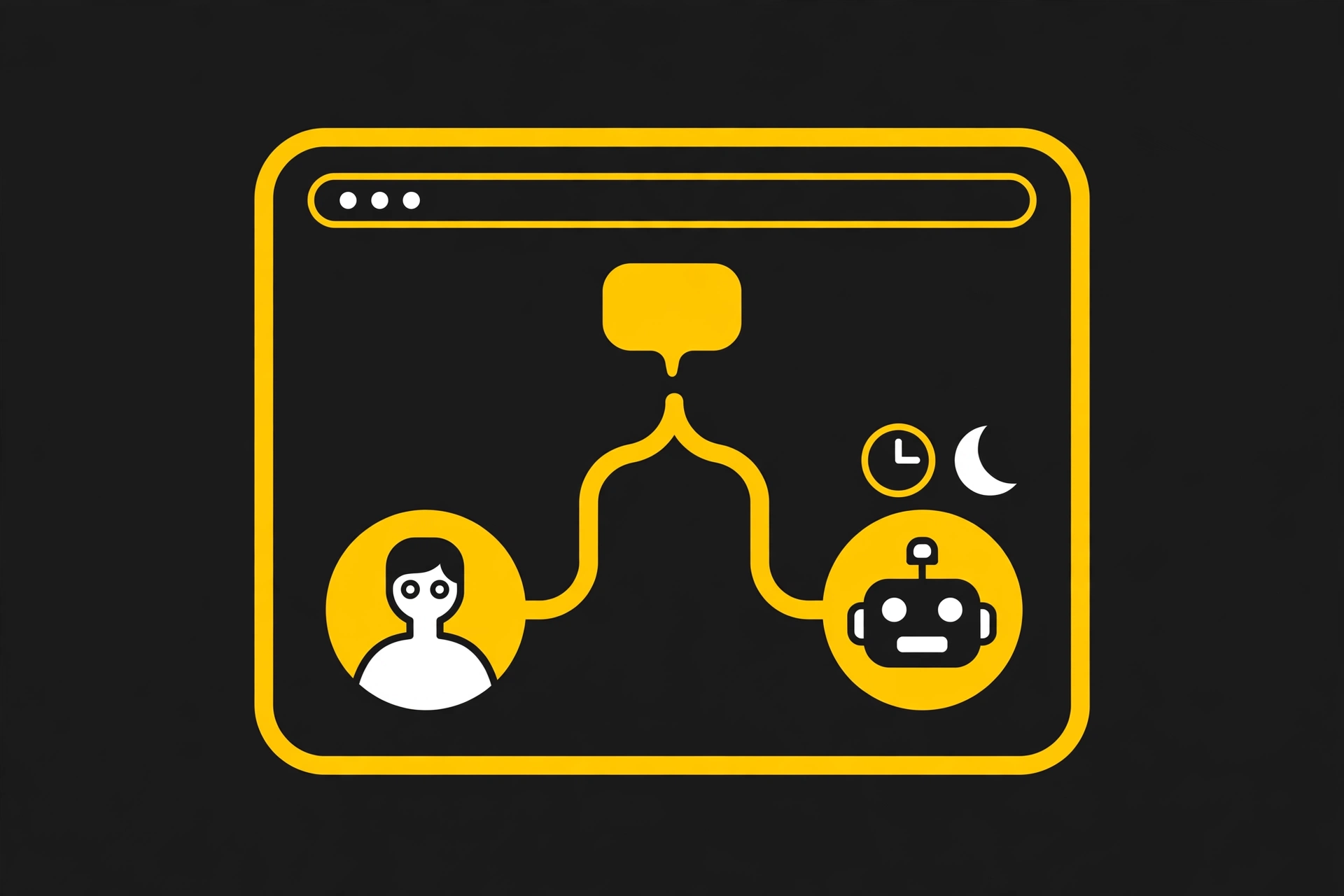
An AI chatbot is automated software trained on your business information. It reads a visitor’s message, understands the question in natural language, and replies instantly, day or night, without a human agent being online.
The difference is simple: live chat trades availability for humanity, while a chatbot trades human judgment for availability and speed. The rest of this guide weighs that trade-off.
What does live chat do well?
Live chat puts a real person behind the chat window, and that brings strengths no script can fully copy:
- Real human judgment. A person understands nuance, handles unusual situations, reads between the lines, and adapts on the spot.
- Trust and warmth. Many customers feel more confident talking to a person, especially for significant purchases or sensitive matters.
- Complex problem-solving. Complaints, special requests, and negotiations are things that need a human brain and human authority.
The weakness is equally obvious: live chat only works when someone is there to answer. Outside business hours, on weekends, or when your team is busy, live chat is either offline or keeps people waiting. And every conversation costs human time.
What does an AI chatbot do well?
An AI chatbot answers automatically, trained on your business information. Its strengths are:
- Always available. Nights, weekends, and holidays: it answers whenever the visitor arrives.
- Instant responses. No queues and no waiting. Every visitor gets an immediate answer, even if many arrive at once.
- Consistency. It gives the same correct answer to the same question, every time.
- Scales easily. Handling ten conversations costs almost the same effort as handling a thousand.
Its weaknesses: it cannot handle truly complex or emotional situations, it only knows what it has been taught, and some customers simply prefer talking to a person. A good chatbot knows its limits and hands over to a human at the right moment.
Live chat vs AI chatbot: head-to-head comparison
| Factor | Live chat | AI chatbot |
|---|---|---|
| Availability | During staffed hours only | 24 hours a day, every day |
| Speed | Fast when quiet, slower when busy | Instant, whatever the volume |
| Complex answers | Excellent: humans handle the unexpected | Limited: handles the expected, escalates the rest |
| Cost structure | Human time, scaling with volume | Upfront setup, then a much flatter ongoing cost |
| Lead capture | During business hours | At any hour, including nights and weekends |
| Customer preference | Preferred for important decisions | Preferred for quick, factual questions |
When is live chat the right choice?
Live chat alone makes sense when your business is built on personal advice: high-value sales with consultation, professional services where trust is everything, or situations where every conversation is genuinely different. It also works when your team already handles chat as part of their daily work and the volume is manageable.
Be honest about one thing: if you install live chat but nobody answers promptly, it is worse than having nothing. A chat window that keeps visitors waiting damages trust instead of building it.
When is an AI chatbot the right choice?
An AI chatbot makes sense when you get the same questions repeatedly, when you lose enquiries outside business hours, when your team is interrupted too often by routine questions, or when your website gets traffic but few of those visitors become contacts. For most small businesses, these conditions are true.
It is also the right choice when you want consistency: every visitor gets the same good answer, the same offer to leave their details, and the same professional first impression.
What about a hybrid setup?
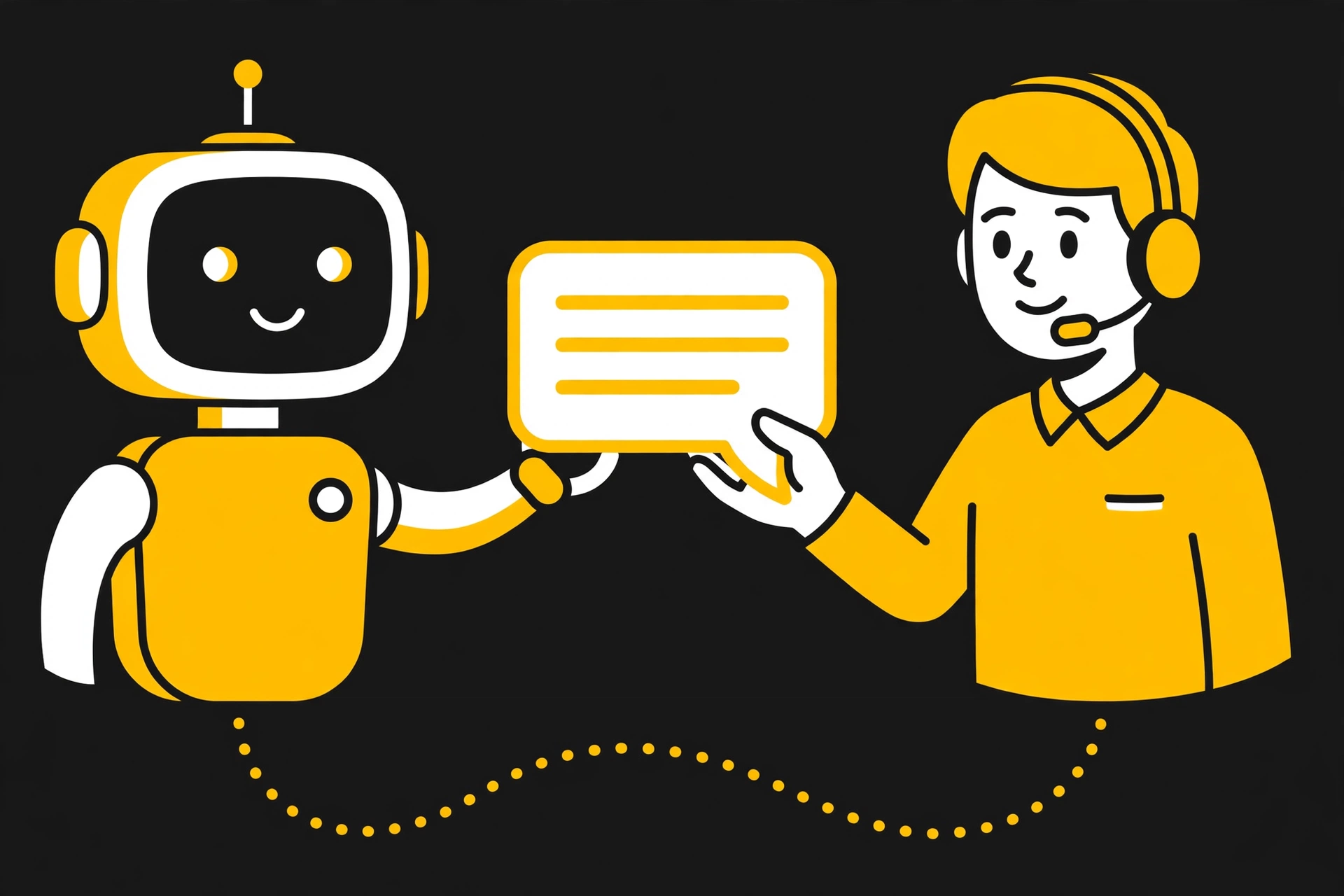
Here is what many successful businesses actually do: the chatbot handles the front line, and humans take over when it matters. The chatbot answers frequent questions instantly, collects contact details, and qualifies the enquiry. When the conversation gets complex, or the visitor asks for a person, it hands over smoothly to your team, with the full conversation history attached.
This gives you 24/7 coverage without 24/7 staffing, instant answers for routine questions, and human warmth where it counts. For most businesses, the hybrid model is not a compromise: it is the best answer.
How do you decide for your business?
Ask yourself three questions before you choose:
- When do your visitors arrive? Check your website analytics. If a meaningful share of visits happens outside your business hours, you need automated coverage for those hours at minimum.
- What do they ask? If most questions are the same handful of questions, a chatbot handles them well. If every conversation is unique, you need humans.
- What does a missed conversation cost you? In businesses where one customer is worth a lot, every missed chat hurts. That usually justifies both: a bot for coverage, and humans for the important conversations.
If you want a deeper look at what chatbots can and cannot do, read our guide on AI chatbots for business websites. And for an honest breakdown of what these projects involve financially, see how much it costs to integrate AI into your website.
What does each option cost?
Let us talk about money honestly, without inventing figures, since costs vary widely:
- Live chat costs human time. That time scales linearly: double the conversations, double the staffing need, or double the waiting times. For a business owner doing it themselves, the cost is their own hours interrupted throughout the day.
- An AI chatbot has an upfront cost (setup, training with your information, testing) and then a much flatter ongoing cost: it handles ten or a thousand conversations for nearly the same. There is also periodic maintenance: reviewing conversations and updating answers.
- The hybrid model combines both costs but optimizes them: the chatbot absorbs the routine volume (the expensive part to staff), and humans handle only the conversations that truly need them (far fewer).
The right comparison is not chatbot versus live chat in the abstract: it is the cost of each option against the cost of your current situation, such as missed enquiries, slow responses, and interrupted workdays.
Frequently asked questions
Can an AI chatbot really understand my customers?
For routine questions, yes: modern AI chatbots understand natural language, including typos and informal phrasing. For unusual, emotional, or complex situations, no: that is exactly when the conversation should be handed to a human. The key is configuring that handover well.
Will customers be annoyed talking to a bot?
Customers are annoyed by bad bots, not by bots. A chatbot that answers instantly and accurately, and clearly offers a human when needed, gets a good reception. What frustrates people is being trapped in useless automated loops with no way out.
Do I need live chat if I already have a chatbot?
Not necessarily as a separate system. The hybrid approach covers it: the chatbot handles the front line and escalates to your team when needed. A standalone live chat widget only makes sense if your team can genuinely answer promptly during business hours.
How long does it take to set up an AI chatbot?
A basic FAQ chatbot can be live within days once your information is gathered. More advanced setups with booking integrations or CRM connections take longer. Either way, plan for a tuning period: reviewing real conversations in the first weeks is what makes it good.
Can the chatbot handle multiple conversations at once?
Yes, and this is one of its biggest advantages over live chat: it handles many simultaneous conversations with the same instant response. A human agent can only handle a few chats at once before quality drops.
The bottom line
Live chat gives you humanity, but only when staffed. An AI chatbot gives you availability and speed, but not judgment. Most businesses do not have to choose: start with the chatbot covering the routine questions and the out-of-hours traffic, keep humans for what matters, and let each do what it does best.
Not sure which setup fits your business? Contact us and tell us how your visitors reach you today, or message us directly on WhatsApp and we will help you decide.